Lots of fizzy bubbles in the glass, and the beer projects an apple-cider aroma. Flavor is moderately strong, actually less than I expected. It has a decent Belgian ale flavor with that lactic tinge of a Flemish sour which I enjoy. That sourness isn't super prevalent, though, just a bit. Mostly it presents as a moderately-spiced Belgian ale with a touch of vinegar. Overall a tasty, but light, fall offering. Good intro to this style and very approachable. It cost $7.49 at Whole Foods for a 500mL bottle, so pretty much a good target.
"Sip and Puff" is the personal blog of food & beverage writer James Liska. That's me! Since 2012, I've written about wine, beer, spirits, food, and restaurants. I focus on fundamental information, tasting notes, and overall thoughts rather than scores, harsh criticism, or arbitrary ratings. This supplements my other work such as writing for District Fray Magazine, creating cocktails, and posting more "everyday" stuff through my Instagram, @baconesque. Enjoy!
Welcome
If you're new here, read this!
Hello! Thanks for visiting my blog. Here you'll find a ton of stuff - over 460 articles...everything from beer reviews, interviews, wi...
Wednesday, October 31, 2018
Right Proper Brewing Co. - "Baron Corvo" biere de garde
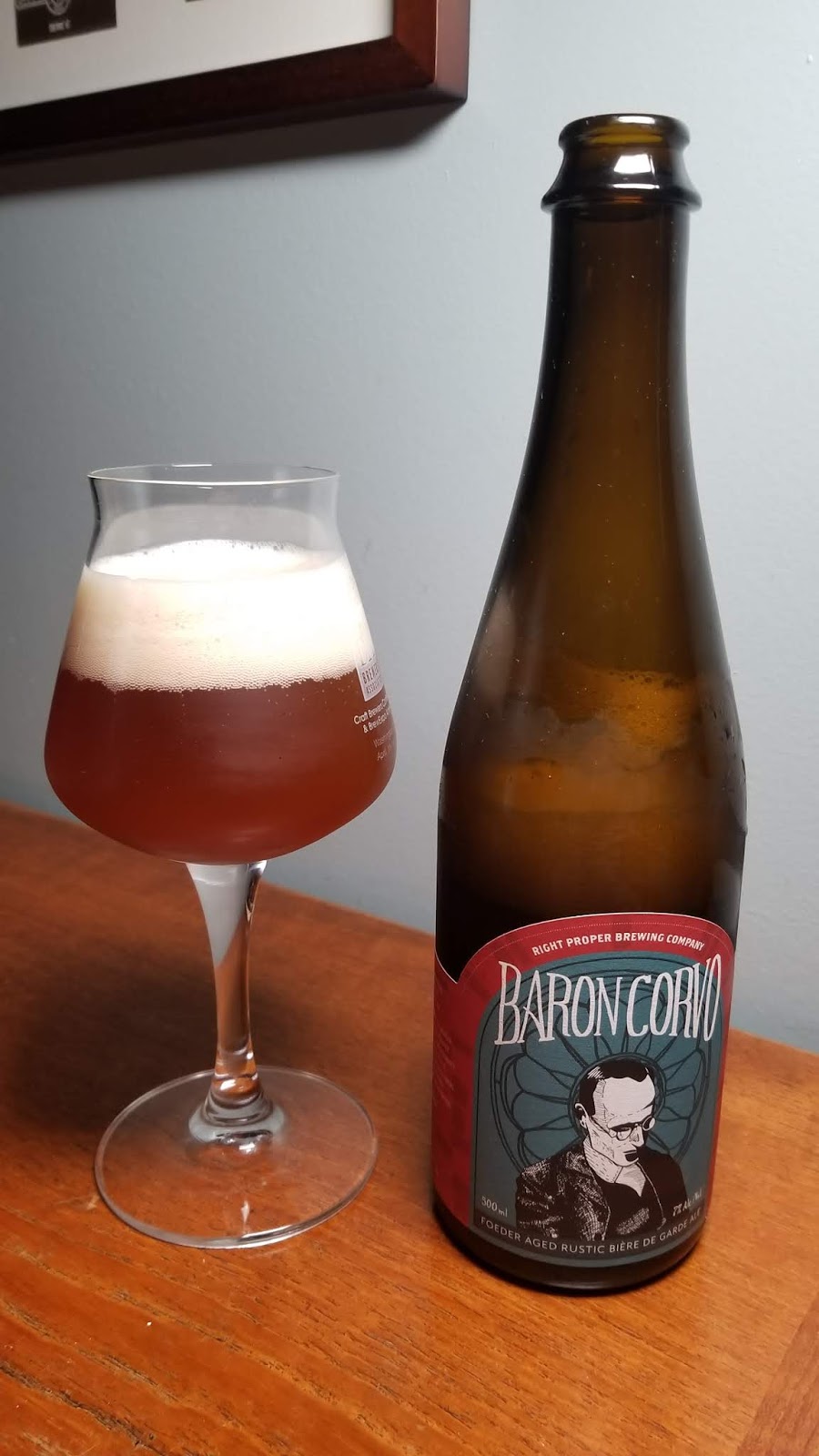
I'm trying to get back in the habit of doing shorter posts, more often, so here's a snapshot of a beer I had the other day. This is Right Proper Brewing's "Baron Corvo", a 7.00% biere de garde, a strong pale ale traditionally brewed in the Nord-Pas-de-Calais region of France. According to All About Beer magazine, this style has its origins in medieval, rural Europe as a source of nutrients and nourishment for peasants toiling in the fields. Today's example is made in DC, of course. We still toil, just in different kinds of fields.
Lots of fizzy bubbles in the glass, and the beer projects an apple-cider aroma. Flavor is moderately strong, actually less than I expected. It has a decent Belgian ale flavor with that lactic tinge of a Flemish sour which I enjoy. That sourness isn't super prevalent, though, just a bit. Mostly it presents as a moderately-spiced Belgian ale with a touch of vinegar. Overall a tasty, but light, fall offering. Good intro to this style and very approachable. It cost $7.49 at Whole Foods for a 500mL bottle, so pretty much a good target.
Saturday, October 20, 2018
Field Recordings - 2015 "FICTION" red blend [Paso Robles, CA]
I grabbed this California red wine at D'Vines one day after my shift; I've seen it on our wine wall for some time, and I admit that in this case, marketing has done its job. The label is quite attractive and modern; it stands out in a sea of traditional plain labels. I took a look, liked what I saw, and decided to give it a try.
This wine is made by Field Recordings, the brainchild of winemaker Andrew Jones. According to his website, Jones is a vinetender who's worked in many vineyards throughout the California coast; he is constantly on the lookout for small, underappreciated vineyards and fruit. From some of the vineyards he's worked, he's been able to reserve some of the fruit grown to make his own wine. These small lots are all single-origin and released under the Field Recordings label.
There are three secondary labels, as well, under the Field Recordings umbrella, including a canned wine (Alloy Wine Works), a label that focuses on Pinot Noir and Chardonnay from so-called "extreme coastal conditions" (Wonderwall), and two multi-vineyard blends (FICTION.) Today's wine is the red version of FICTION. It's a mixmaster blend of:
It projects a very pleasing aroma; a little grape, a little fruit, a little spice. Nothing particularly unbalanced.
Initially, I'm tasting some unripe grapes flavors and a burst of tannins on the front end, which dies away quickly and leads to a very soft, slightly sweet flavors. The wine develops into cassis, with a bit of leather paired with some alcohol esters, and a touch of allspice. It goes out like a lamb, though, finishing soft and silky, with lots of cherry juice flavors. The aftertaste is a bit dry with a slight metallic tinge.
Overall, super nice and a very approachable red, and would pair well with numerous dishes. I liked the softness on the finish the most, it was just dry enough to cut through the rich and creamy mac 'n cheese. The berry flavors and a bit of spice makes it an approachable, middle-of-the-road wine that's done quite nicely.
The winery's website bills this as a "wine for every occasion" and I'd say that's partially true. The blend is solid and although I couldn't necessarily pick out each individual grape variant, I did enjoy each of the flavors in harmony. The $21.99 price tag prevents from being a true diamond in the rough, though, but it's well worth a try. Field Recordings has a few other offerings, including a hoppy wine (!) which I will eventually track down and try.
This wine is made by Field Recordings, the brainchild of winemaker Andrew Jones. According to his website, Jones is a vinetender who's worked in many vineyards throughout the California coast; he is constantly on the lookout for small, underappreciated vineyards and fruit. From some of the vineyards he's worked, he's been able to reserve some of the fruit grown to make his own wine. These small lots are all single-origin and released under the Field Recordings label.
There are three secondary labels, as well, under the Field Recordings umbrella, including a canned wine (Alloy Wine Works), a label that focuses on Pinot Noir and Chardonnay from so-called "extreme coastal conditions" (Wonderwall), and two multi-vineyard blends (FICTION.) Today's wine is the red version of FICTION. It's a mixmaster blend of:
- 48% Zinfandel
- 15% Syrah
- 14% Mourvedre
- 8% Graciano (a new one for me)
- 8% Cabernet Sauvignon
- 4% Touriga Nacional (also new)
- 3% Carignan
OK, so, I can appreciate a good red blend just as much as the next guy, but having seven different grapes in this wine seems a bit excessive. I imagine it would be tough for anyone to pick out the individual characteristics of each grape. Such small percentages, as well, make me question the decision; for example, the Carignan makeup of this blend is 3%, which in terms of a 750mL bottle, is only 1.5 tablespoons. That's not a lot of flavor to add to a wine and I'd wager most people wouldn't tell the difference if it was omitted. This is not the only wine that does this....another example is Boekenhoutskloof's "The Wolf Trap", which is a blend of Syrah, Mourvedre, and...1% Viognier. I mean, come on. 1%? That's only 1.5 teaspoons in an entire bottle. Crazy.
I had some extra time on my hands, so I was planning on trying this wine and pairing with my homemade truffle and bacon mac n' cheese.
I precooked the bacon, and used the bacon fat for the roux. As all that was going on, I poured out the wine using my new Vintorio aerator. The wine world is divided on the use of aerators; I think it's fine and helps the wine breathe. Some feel it's a gimmick, but hey, if it agitates the wine more than a simple pour, it's got to have some effect, right?
I had some extra time on my hands, so I was planning on trying this wine and pairing with my homemade truffle and bacon mac n' cheese.
I precooked the bacon, and used the bacon fat for the roux. As all that was going on, I poured out the wine using my new Vintorio aerator. The wine world is divided on the use of aerators; I think it's fine and helps the wine breathe. Some feel it's a gimmick, but hey, if it agitates the wine more than a simple pour, it's got to have some effect, right?
It projects a very pleasing aroma; a little grape, a little fruit, a little spice. Nothing particularly unbalanced.
Initially, I'm tasting some unripe grapes flavors and a burst of tannins on the front end, which dies away quickly and leads to a very soft, slightly sweet flavors. The wine develops into cassis, with a bit of leather paired with some alcohol esters, and a touch of allspice. It goes out like a lamb, though, finishing soft and silky, with lots of cherry juice flavors. The aftertaste is a bit dry with a slight metallic tinge.
Overall, super nice and a very approachable red, and would pair well with numerous dishes. I liked the softness on the finish the most, it was just dry enough to cut through the rich and creamy mac 'n cheese. The berry flavors and a bit of spice makes it an approachable, middle-of-the-road wine that's done quite nicely.
The winery's website bills this as a "wine for every occasion" and I'd say that's partially true. The blend is solid and although I couldn't necessarily pick out each individual grape variant, I did enjoy each of the flavors in harmony. The $21.99 price tag prevents from being a true diamond in the rough, though, but it's well worth a try. Field Recordings has a few other offerings, including a hoppy wine (!) which I will eventually track down and try.
Saturday, October 6, 2018
Napa Wine Company - Where history, heritage, wine, and business meet
I visited a number of wineries and tasting rooms during my California trip, and each had their own attraction and appeal. From the larger, corporate wineries like Taittinger Domaine Chandon to the tiny, mom-and-pop places like Storybook Mountain, there's over 500 wineries in Napa Valley, and each with their own style and approach. Some wineries are super focused on one style or grape; others make a little of everything, and some focus more on production than they do the customer experience. Some vineyards may not even sell directly to consumers, opting instead to sell their grapes to other vineyards. The world of commercial winemaking is quite complex to say the least.
When I was in California, I wanted to review a larger winery that combined heritage, production, and quality. Napa Wine Company fits the bill perfectly. It's a large multi-brand winery, located in Yountville, CA, about 14 miles down the road from where we were staying in Calistoga. Situated on St. Helena Highway - the "Strip" of Napa Valley, as I like to call it - this land has a deep and rich history. Once farmland for vegetables, grapes have been grown on this property for over a century. Joseph Pelissa, the son of Italian farmers, moved to Napa Valley in 1902, and for ten dollars in gold, purchased 35 acres of farmland.
Even through that nasty Prohibition business, the farms and vineyards prospered. They expanded their businesses to other sectors, but kept their grape plots, and today, the property stretches across hundreds of acres. I was fortunate enough to take a guided tour of this historic property with Kendall Hoxsey-Onysko, business manager of Napa Wine Company and a fellow Dickinson alum. Kendall is a fifth-generation winemaker and the great-great-grandaughter of Joseph Pelissa.
We started with a guided tour of the properties, which required a bit of driving. Napa Wine Company is comprised of six sprawling plots, each of varying acreage and production. They are:
So lots of space and lots of grapes! Luckily they have not been affected by fire recently - the fires of the last year or so haven't come down to the valley floor. Part of this has to do with geography and fire dynamics, but it also helps that there's a herd of cattle at the vineyard, which make natural firebreaks by grazing, so even if a fire were to come down, there would be some mitigation.
But fire isn't the only issue facing vineyards - cold can hurt them too! If you find yourself in a vineyard and see big windmill-type things, you're looking at a wind machine which is used for frost protection.
A few notes about harvesting, which is taking place as we speak. Each vineyard harvests their grapes in a different way. Some have huge machines that knock grapes out of the vines and onto a conveyor belt; this is faster but less care is taken in the handling of grapes. Another approach is hand-picking, where crews go through each vine and evaluate grapes proper ripeness before picking. This also means they are more discerning with which grapes are picked; they can also be gentler. This also not to mention some places, like steep hillsides, where mechanical harvesters wouldn't be able to go.
Like I said, each place does it differently. Storybook hand-harvests with the same crew who have worked the land there each season (including a few who have been with the Seps since Storybook opened). We had also visited Rutherford Cellars, which also hand-picks, but they harvest at night, as they feel it's easier to keep their crew warm at night than it is to cool them on a hot day.
Back to NWC. Unlike Storybook, they have no caves (yet.) They do, however, have a 10,000-barrel storehouse, filled to the brim with Hungarian, American, and French oak barrels filled with wine from all their client companies and all their vineyards.
NW produces wines under numerous labels, many of which are resting on oak right this moment. I'll do a tasting a bit later. But notice above that I used the phrase "client companies." That's because NWC also offers "custom crush" services, and this is a very important concept to understand.
Starting a winery is extremely difficult, and requires massive startup capital....not to mention finding a suitable site for vines, purchasing equipment, fees, and buying the vines or having them custom grafted. Time is important, too - according to Kendall, it takes about three years from planting grapes to cash flow. Additionally, a new winemaker may not have access to the expertise required to make wine! This is a complicated venture.
So let's say you've managed to find a good place for grapes, and you have the money to start planting. You tend your vines, assiduously, and come out with an annual yield of three tons of grapes. Great. What next? You don't have the capacity or production facilities large enough for a full-scale winemaking effort! In this case, you'd want to invest in a custom crush - meaning bringing your grapes, or the pressed juice, to a place like NWC, where they can make your wine for you in their facility.
According to Vinepair.com's Adam Teeter, a Type-02 vintner's license is still required to make wine this way; however a custom crush facility allows would-be winemakers to "completely avoid the cost of maintaining [one's] own facility", enabling a farmer to focus on growing and not raising money for facilities. In fact, some vineyards don't have production facilities at all, and they solely rely on custom crush services to produce their wines.
NWC also has an on-site wine lab, which I toured. Here clients can perform a variety of tests and quality control measures on wine, including testing for residual sugars, dissolved oxygens, and sulfur. Doing these tests here can ensure that the chemistry aspect of winemaking is taken care of, and that any QC tests that need to be run can be done without having to send sample off for analysis. Winemaking is a complicated process, but as you can see, NWC has all the tools available for winemakers to make, bottle, and test their wines.
The extensive tour of the facilities concluded, and now, on to the tasting.
As you can see, I had quite a bit. Luis, my tasting guide today, was knowledgeable and patient as I tried a ton of wine. I'll choose a couple of the glasses to review, and then will review some of the bottles I bought at a later date, once they're shipped.
First up is a 2014 Red Mare chardonnay, from the Dutton Ranch vineyard in the Russian River Valley. It's one of NWC's client companies.
Next up is a 2015 Cabernet Sauvignon; it's part of NWC's Ghost Block line of wines.
Grown in the Rock Cairn parcel, this estate wine is a bit salty, but velvety soft though. Solid notes of dark grape skins, with a hint of some port sugar on the long lingering finish. Nice big bold wine; I ended up getting a bottle of this shipped to me. They should be arriving soon!
Last up is "Ottimino", a 2014 estate Zinfandel from the Russian River Valley.

When I was in California, I wanted to review a larger winery that combined heritage, production, and quality. Napa Wine Company fits the bill perfectly. It's a large multi-brand winery, located in Yountville, CA, about 14 miles down the road from where we were staying in Calistoga. Situated on St. Helena Highway - the "Strip" of Napa Valley, as I like to call it - this land has a deep and rich history. Once farmland for vegetables, grapes have been grown on this property for over a century. Joseph Pelissa, the son of Italian farmers, moved to Napa Valley in 1902, and for ten dollars in gold, purchased 35 acres of farmland.
Even through that nasty Prohibition business, the farms and vineyards prospered. They expanded their businesses to other sectors, but kept their grape plots, and today, the property stretches across hundreds of acres. I was fortunate enough to take a guided tour of this historic property with Kendall Hoxsey-Onysko, business manager of Napa Wine Company and a fellow Dickinson alum. Kendall is a fifth-generation winemaker and the great-great-grandaughter of Joseph Pelissa.
We started with a guided tour of the properties, which required a bit of driving. Napa Wine Company is comprised of six sprawling plots, each of varying acreage and production. They are:
- Rock Cairn vineyard - high-end Cabernet; 40 acres.
- Morgaen Lee - this is mostly sauvignon blanc. Ghost Block made here
- Block House - 292 acres, their largest parcel. Mostly Syrah and Malbec, there's also some Flora tossed in (a hybrid Semillon / Gewurztraminer grape, invented in 1938 in California.)
- Pelissa - 11 acres of Zinfandel, and a smattering of Malbec, Petit Verdot, and Cabernet Franc
- Lincoln Creek - 60 acres of Zinfandel, Cabernet Sauvignon, and Chardonnay
- Mill Race - 36 acres of Cabernet Sauvignon, Petit Verdot, and Cabernet Franc
So lots of space and lots of grapes! Luckily they have not been affected by fire recently - the fires of the last year or so haven't come down to the valley floor. Part of this has to do with geography and fire dynamics, but it also helps that there's a herd of cattle at the vineyard, which make natural firebreaks by grazing, so even if a fire were to come down, there would be some mitigation.
But fire isn't the only issue facing vineyards - cold can hurt them too! If you find yourself in a vineyard and see big windmill-type things, you're looking at a wind machine which is used for frost protection.
![]() |
| A super old, gnarly vine |
A few notes about harvesting, which is taking place as we speak. Each vineyard harvests their grapes in a different way. Some have huge machines that knock grapes out of the vines and onto a conveyor belt; this is faster but less care is taken in the handling of grapes. Another approach is hand-picking, where crews go through each vine and evaluate grapes proper ripeness before picking. This also means they are more discerning with which grapes are picked; they can also be gentler. This also not to mention some places, like steep hillsides, where mechanical harvesters wouldn't be able to go.
![]() |
| A grape harvest somewhere in France. File photo: Reuters |
Like I said, each place does it differently. Storybook hand-harvests with the same crew who have worked the land there each season (including a few who have been with the Seps since Storybook opened). We had also visited Rutherford Cellars, which also hand-picks, but they harvest at night, as they feel it's easier to keep their crew warm at night than it is to cool them on a hot day.
Back to NWC. Unlike Storybook, they have no caves (yet.) They do, however, have a 10,000-barrel storehouse, filled to the brim with Hungarian, American, and French oak barrels filled with wine from all their client companies and all their vineyards.
NW produces wines under numerous labels, many of which are resting on oak right this moment. I'll do a tasting a bit later. But notice above that I used the phrase "client companies." That's because NWC also offers "custom crush" services, and this is a very important concept to understand.
Starting a winery is extremely difficult, and requires massive startup capital....not to mention finding a suitable site for vines, purchasing equipment, fees, and buying the vines or having them custom grafted. Time is important, too - according to Kendall, it takes about three years from planting grapes to cash flow. Additionally, a new winemaker may not have access to the expertise required to make wine! This is a complicated venture.
So let's say you've managed to find a good place for grapes, and you have the money to start planting. You tend your vines, assiduously, and come out with an annual yield of three tons of grapes. Great. What next? You don't have the capacity or production facilities large enough for a full-scale winemaking effort! In this case, you'd want to invest in a custom crush - meaning bringing your grapes, or the pressed juice, to a place like NWC, where they can make your wine for you in their facility.
According to Vinepair.com's Adam Teeter, a Type-02 vintner's license is still required to make wine this way; however a custom crush facility allows would-be winemakers to "completely avoid the cost of maintaining [one's] own facility", enabling a farmer to focus on growing and not raising money for facilities. In fact, some vineyards don't have production facilities at all, and they solely rely on custom crush services to produce their wines.
![]() |
| Some cool square fermenters in NWC's facility. |
NWC also has an on-site wine lab, which I toured. Here clients can perform a variety of tests and quality control measures on wine, including testing for residual sugars, dissolved oxygens, and sulfur. Doing these tests here can ensure that the chemistry aspect of winemaking is taken care of, and that any QC tests that need to be run can be done without having to send sample off for analysis. Winemaking is a complicated process, but as you can see, NWC has all the tools available for winemakers to make, bottle, and test their wines.
The extensive tour of the facilities concluded, and now, on to the tasting.
As you can see, I had quite a bit. Luis, my tasting guide today, was knowledgeable and patient as I tried a ton of wine. I'll choose a couple of the glasses to review, and then will review some of the bottles I bought at a later date, once they're shipped.
First up is a 2014 Red Mare chardonnay, from the Dutton Ranch vineyard in the Russian River Valley. It's one of NWC's client companies.
Pours a clearish gold, perhaps a tiny bit of green in there. It's aged for ten months on French oak. Nice balance of flavors - there's a noticeable oak tang, accompanied by some honey, but nothing super grassy or buttery. Can't really detect much fruit, or anything beyond that. Clear finish. I think this would go great with some chicken alfredo.
Grown in the Rock Cairn parcel, this estate wine is a bit salty, but velvety soft though. Solid notes of dark grape skins, with a hint of some port sugar on the long lingering finish. Nice big bold wine; I ended up getting a bottle of this shipped to me. They should be arriving soon!
Last up is "Ottimino", a 2014 estate Zinfandel from the Russian River Valley.
I love Zinfandel, and this is really up my alley. Very grapey with nice bold flavors of dried fruit and spice. It has that puckery "lip-smacking" finish that I love in red wine. There's just enough saltiness to keep my attention without overdoing it. I ended up getting a bottle of this, as well.
Although I tried about ten other wines, I wanted to just highlight a few. I've rambled enough - so thank you for reading! Big thanks to my brother Dan for waking up early on vacation to drive me from Calistoga to Oakville; huge thanks as well to Luis for spending part of his morning with me tasting wine and giving advice.
But biggest thanks to Kendall for taking time out of her busy day to meet with me and to show me around; driving all around the Valley and patiently answer my dozens of questions about the facilities, operations, vineyards, grapes, etc.
If you're ever in Oakville, do visit Napa Wine Company at 7830 - 40 St. Helena Highway, Oakville CA.

Monday, September 24, 2018
Anheuser-Busch - Budweiser Reserve "Copper Lager"
So we got this into the shop a few weeks back, and having never reviewed an Anheuser-Busch product before, I figured I'd give it a go. I've never seen any Budweiser product outside the normal red-colored bottles or cans, and so I was kind of surprised to see something craft-y from this megabrewery. Some of my colleagues were curious, too, and so we split this sixer three ways and each got two. This goes for $8.99, so I spent $3 on two bottles.
According to Vince Brennan at the St. Louis Business Journal, this 6.20% ABV ale is made with two-row barley and is aged on Jim Beam bourbon barrel staves. Brennan also adds that this is the third iteration in Bud's "Reserve Collection" line, which has other entries like their "Freedom Reserve", an ale made according to George Washington's recipe. Seems fun - I'd never heard of Budweiser venturing into this realm, but makes sense given the popularity of craft beer. Budweiser has practically unlimited resources, so it figures that they might try their hand at fancier products.
Pours a clear amber, and generates a fluffy off-white head. Lots of ts of tiny bubbles. Smells kinda like cheap whiskey, actually.
You know, actually, this is not terrible. A stunning endorsement, I know. This beer is thin, as expected, with lots of fizz. Like regular Budweiser, it's malty, slightly sweet, with flavors of stale wheat. The Jim Beam barrels definitely adds a flavor of slightly-sour, inexpensive whiskey, mostly on the aftertaste. Not getting a lot of oak, per se, but definitely tasting the whiskey. It doesn't taste artificial, but it does have a bit of sourness. But definitely drinkable.
A big issue here is the cost. It's $8.99, which is on the low end for craft beer, but on the high end for mass-produced stuff. While this was good to try once, you can get craft beer of much better quality for only a dollar or so more. Aside from any brand loyalty someone might have to either Budweiser or Jim Beam, I see no real reason to spend this amount of money on this beer. If it was $5.99 for six, I'd still say no because you can get Narragansett for that (and more of it, too). Best just to avoid this, or try it on draft somewhere if you're really curious.
According to Vince Brennan at the St. Louis Business Journal, this 6.20% ABV ale is made with two-row barley and is aged on Jim Beam bourbon barrel staves. Brennan also adds that this is the third iteration in Bud's "Reserve Collection" line, which has other entries like their "Freedom Reserve", an ale made according to George Washington's recipe. Seems fun - I'd never heard of Budweiser venturing into this realm, but makes sense given the popularity of craft beer. Budweiser has practically unlimited resources, so it figures that they might try their hand at fancier products.
Pours a clear amber, and generates a fluffy off-white head. Lots of ts of tiny bubbles. Smells kinda like cheap whiskey, actually.
You know, actually, this is not terrible. A stunning endorsement, I know. This beer is thin, as expected, with lots of fizz. Like regular Budweiser, it's malty, slightly sweet, with flavors of stale wheat. The Jim Beam barrels definitely adds a flavor of slightly-sour, inexpensive whiskey, mostly on the aftertaste. Not getting a lot of oak, per se, but definitely tasting the whiskey. It doesn't taste artificial, but it does have a bit of sourness. But definitely drinkable.
A big issue here is the cost. It's $8.99, which is on the low end for craft beer, but on the high end for mass-produced stuff. While this was good to try once, you can get craft beer of much better quality for only a dollar or so more. Aside from any brand loyalty someone might have to either Budweiser or Jim Beam, I see no real reason to spend this amount of money on this beer. If it was $5.99 for six, I'd still say no because you can get Narragansett for that (and more of it, too). Best just to avoid this, or try it on draft somewhere if you're really curious.
Monday, September 10, 2018
Corvelia - 2016 red blend [Paso Robles, CA]
A fun part of writing this blog is trying new, random things on a whim. Today's wine I grabbed at Trader Joe's a few weeks back, mostly purchased since it was at the right price point for an "everyday" wine - $9.99. It's called "Corvelia", and is a California wine from the Paso Robles region in south-central California.
But that's kind of all the information we have. Some bottles of wine have tons of details on the label - grape blends, information about the vineyards, who made them, their family history, tasting notes, etc. Some don't. This one doesn't. All it says on the back of the bottle is "v. 2016. Corvelia red wine. A unique blend of grapes, sustainably grown and harvested from the rolling hills of Paso Robles."
It's not unusual for some wines not to provide this specific information. This could be for a variety of reasons: maybe they don't want you to know that there's 15 different grapes in there; or maybe they bought refuse grapes from a top-tier vineyard (ala Trader Joe's house blends) and that vineyard doesn't want you to know that their $100-a-bottle grapes are available for a tenth of that price. This is common practice, and there's nothing terribly shady about it.
So let's check it out. It's a blood red in the glass, and candles clear. My camera does not pick up red that well through light, so I may stop candling wines for these posts. It's not purple, despite the below picture.
The wine produces a lively aroma of tannins - a spicy aroma. The wine itself very thick, with a velvety texture that coats the mouth. Flavor-wise, I'm detecting some leather and tobacco and maybe some plum. Big burst of wood. Not a lot of brightness or jamminess - all deep, dark flavors. The finish has some smoke, too, with a tiny metallic tinge on the aftertaste. This metallic note lasts for quite a while after swallowing.
I think this is sort of what "normal" wine drinkers would expect to call a "strong" wine...not strong in terms of alcohol (we would call that "hot" in the wine business) but strong in terms of intensity of flavor. Wine that has strong, aggressive flavoring - especially of unfinished alcohol - is sometimes called "brawny" by wine professionals. It's a quality you want to avoid in fine wines, but for everyday wines under $10, it's not wholly unexpected. As such, I have a feeling this'll stand up to whatever dish you throw at it, and in terms of pairing, I had this with my famous homemade sriracha and pepper-jack mac n' cheese. So give this a try!
But that's kind of all the information we have. Some bottles of wine have tons of details on the label - grape blends, information about the vineyards, who made them, their family history, tasting notes, etc. Some don't. This one doesn't. All it says on the back of the bottle is "v. 2016. Corvelia red wine. A unique blend of grapes, sustainably grown and harvested from the rolling hills of Paso Robles."
It's not unusual for some wines not to provide this specific information. This could be for a variety of reasons: maybe they don't want you to know that there's 15 different grapes in there; or maybe they bought refuse grapes from a top-tier vineyard (ala Trader Joe's house blends) and that vineyard doesn't want you to know that their $100-a-bottle grapes are available for a tenth of that price. This is common practice, and there's nothing terribly shady about it.
So let's check it out. It's a blood red in the glass, and candles clear. My camera does not pick up red that well through light, so I may stop candling wines for these posts. It's not purple, despite the below picture.
The wine produces a lively aroma of tannins - a spicy aroma. The wine itself very thick, with a velvety texture that coats the mouth. Flavor-wise, I'm detecting some leather and tobacco and maybe some plum. Big burst of wood. Not a lot of brightness or jamminess - all deep, dark flavors. The finish has some smoke, too, with a tiny metallic tinge on the aftertaste. This metallic note lasts for quite a while after swallowing.
I think this is sort of what "normal" wine drinkers would expect to call a "strong" wine...not strong in terms of alcohol (we would call that "hot" in the wine business) but strong in terms of intensity of flavor. Wine that has strong, aggressive flavoring - especially of unfinished alcohol - is sometimes called "brawny" by wine professionals. It's a quality you want to avoid in fine wines, but for everyday wines under $10, it's not wholly unexpected. As such, I have a feeling this'll stand up to whatever dish you throw at it, and in terms of pairing, I had this with my famous homemade sriracha and pepper-jack mac n' cheese. So give this a try!
Sunday, August 26, 2018
Marin Brewing Co. - "Bluebeery" ale
Whenever I travel, I'm always on the lookout for simple, tasty beer that doesn't require an extended tasting session (or a trip to Sonoma County) to enjoy. Today's post focuses on one such beer - a 5.00% ABV ale made with blueberries, coming from Larkspur, CA-based Marin Brewing Co.
We were actually going to visit the taproom, which is located right in Larkspur Landing where one can pick up the ferry into San Francisco (it's a fun trip!) Our schedule changed and our new plans didn't permit an in-person visit, unfortunately, but luckily I found a few bottles of Marin Brewing beer in the Novato Whole Foods to try.
A word about berry beers, in general - honestly, I've never been that impressed by them. Berries are a fun ingredient, and they go with a lot of things, but every berry beer (with perhaps the exception of Empyrean's "Pitched Blue") has fallen flat to me. Each one I've tried is either too sugary or too thin; or in the case of a gose, too sour. In their purest form, I think I've only had Midwest or East Coast berry beers, so I'm curious to see how the Left Coast folks handle the style.
According to the label: "...We use only the finest ingredients: Malt from Washington and Wisconsin, hops from the Yakima Valley in Washington, Marin County's own water, and a carefully selected strain of yeast." That's cool. Marin County has pretty good water, I'm told, so I guess I can't complain. Let's crack it open.
Hmmm, okay, this is interesting. It's very, very light, but in terms of heaviness / texture, not of flavor. I'm getting a solid flavor of caramel malts, with some wheat sheaf / cereal flavors, and a blueberry juice throughout. The blueberrry is most pronounced on the finish, as the air mixes with what's left on your tongue. The aftertaste has a nice touch of wheat, which doesn't last too long.
I think the texture is what strikes me most about this. The blueberry flavors are fine - mostly juice, a bit sugary - but when it comes to the softness, it's almost like light beer. I like that it's not super flashy, made in a straightforward fashion with a handful of good ingredients, and has a price point suitable for everyday drinking. A good find! I think this was something like $5.99 for a 22oz bomber, so definitely cheap enough to enjoy on the regular.
We were actually going to visit the taproom, which is located right in Larkspur Landing where one can pick up the ferry into San Francisco (it's a fun trip!) Our schedule changed and our new plans didn't permit an in-person visit, unfortunately, but luckily I found a few bottles of Marin Brewing beer in the Novato Whole Foods to try.
A word about berry beers, in general - honestly, I've never been that impressed by them. Berries are a fun ingredient, and they go with a lot of things, but every berry beer (with perhaps the exception of Empyrean's "Pitched Blue") has fallen flat to me. Each one I've tried is either too sugary or too thin; or in the case of a gose, too sour. In their purest form, I think I've only had Midwest or East Coast berry beers, so I'm curious to see how the Left Coast folks handle the style.
According to the label: "...We use only the finest ingredients: Malt from Washington and Wisconsin, hops from the Yakima Valley in Washington, Marin County's own water, and a carefully selected strain of yeast." That's cool. Marin County has pretty good water, I'm told, so I guess I can't complain. Let's crack it open.
It's darker than I was expecting, actually. Pours a deep amber, and generates some thick buff-colored foam. It generates a light, apple cidery nose....also curious.
Hmmm, okay, this is interesting. It's very, very light, but in terms of heaviness / texture, not of flavor. I'm getting a solid flavor of caramel malts, with some wheat sheaf / cereal flavors, and a blueberry juice throughout. The blueberrry is most pronounced on the finish, as the air mixes with what's left on your tongue. The aftertaste has a nice touch of wheat, which doesn't last too long.
I think the texture is what strikes me most about this. The blueberry flavors are fine - mostly juice, a bit sugary - but when it comes to the softness, it's almost like light beer. I like that it's not super flashy, made in a straightforward fashion with a handful of good ingredients, and has a price point suitable for everyday drinking. A good find! I think this was something like $5.99 for a 22oz bomber, so definitely cheap enough to enjoy on the regular.
Saturday, August 11, 2018
La Gran Fabrica Drew Estate / Caldwell Cigar Company - "All Out Kings"
So I haven't done a cigar post in a long time, mostly because blog readers looking for cigar reviews are few and far between (yet somehow it's what people seem to remember most when I tell them about the blog...) Granted, it's not my main focus, nor is something to which most people can relate, but I've been enjoying the hobby for over 12 years now and like to include them here because, just like beer or wine, there's a world of different flavors, techniques, and strains of tobacco out there. Plus sometimes they can be as rare and desirable as a fancy wine!
During my trip I spent a few days out in Inverness, California before returning to San Francisco. I packed this cigar as one of the highlight smokes of my trip; I grabbed it at the Cigars International store in Pennsylvania back in February and have been looking forward to smoking it since.
This cigar is a three-way collaboration between Drew Estate founder Jonathan Drew; Drew Estate master blender (and El Titan de Bronce alum) Willy Herrera; and Caldwell Cigar Co. tsar Robert Caldwell. These three guys are known for their bold, in-your-face cigars, and I got a chance to meet each of them at the Connecticut Barn Smoker event I attended back in August of 2016, at which they announced the release of today's cigar. They even raffled off a few boxes, which of course I didn't win.
So what's under the hood? The innards are made from Dominican and Nicaraguan longfillers, paired with an Indonesian Sumatran binder, and finished with a stalk-cut Connecticut Habano wrapper.
I know from previous experience that the Sumatra leaf is known to be spicy and a touch sweet, and in general Connecticut tobacco is much milder and softer. A note about "longfillers" - you may see this term used to describe the filler of a cigar. Longfillers are essentially long strands of tobacco used as filler for a cigar. This gives the cigar body and consistency and progress, as opposed to shortfillers which are chopped-up bits of tobacco blended together and may be a mix of many kinds. Common wisdom is that longfillers are better, as it's one long strand of the same leaf, therefore providing more consistency.
So given the ingredients I listed above, I'm expecting a somewhat-lighter and more-refined version of a Liga Privada "T52" or a "No. 9." Some of these special-edition smokes are surprisingly light, though, so while I won't be expecting a massive, dark nicotine bomb with sweet, oily flavors, I still think there will be some weight to it. The color of the cigar is a bit lighter than something like the T52 (or a Nica Rustica, for that matter) but that's to be expected - this is a Connecticut Habano, not some dark-as-night Mexican wrapper.
I pre-cut it before my trip with my Colibri V-Cut, intending on smoking a month or so prior. But I saved it once my vacation was planned, and in the interim, the capa cracked a bit, unfortunately, so I had to peel a bit of it off.
First light is a bit tough; it takes a few "turns" of the cigar to get it fully lit. The first third of this cigar is quite surprising. There's a lot less flavors than I was expecting; as noted above I was totally expecting this to be an uppercut of a smoke, but it's really surprising me. As it warms up and I smoke it a bit, I realize that it's not that there's no flavors, but they're very subtle... there's some wood / hickory in there, with some roasted bit salty and minerally...kind of like the red peanut skins inside of the peanut shell. That's the best way I can describe it, and these flavors - although a bit hard to find - are noticeable and begin to build throughout the second third of the cigar, and keep holding on through the final third. This stick, for what it's worth, lasted almost down to the nub. Lots of flavor fidelity here, which is great. I could taste the same (or very similar) flavors from the end of the first third through the end of the final third - not a common occurrence, I tell you.
In terms of price - probably at the higher end of what I would pay. On CI.com they are $265.99 for twenty cigars, or $73 for five. At $14.50 a pop, not cheap. There are some smaller vitolas available - for example, their 5.7x46 corona sized named "Give Me Your Lunch Money" - costs $61 for 5 sticks.
So I think if you're into cigars with softer flavors, and enjoy more mineral notes, this might be a cigar to seek out. Sure, it's expensive, and not something you'd have every day, but it's a good example of a very nuanced cigar made by expert blenders and craftsmen.
During my trip I spent a few days out in Inverness, California before returning to San Francisco. I packed this cigar as one of the highlight smokes of my trip; I grabbed it at the Cigars International store in Pennsylvania back in February and have been looking forward to smoking it since.
This cigar is a three-way collaboration between Drew Estate founder Jonathan Drew; Drew Estate master blender (and El Titan de Bronce alum) Willy Herrera; and Caldwell Cigar Co. tsar Robert Caldwell. These three guys are known for their bold, in-your-face cigars, and I got a chance to meet each of them at the Connecticut Barn Smoker event I attended back in August of 2016, at which they announced the release of today's cigar. They even raffled off a few boxes, which of course I didn't win.
I know from previous experience that the Sumatra leaf is known to be spicy and a touch sweet, and in general Connecticut tobacco is much milder and softer. A note about "longfillers" - you may see this term used to describe the filler of a cigar. Longfillers are essentially long strands of tobacco used as filler for a cigar. This gives the cigar body and consistency and progress, as opposed to shortfillers which are chopped-up bits of tobacco blended together and may be a mix of many kinds. Common wisdom is that longfillers are better, as it's one long strand of the same leaf, therefore providing more consistency.
So given the ingredients I listed above, I'm expecting a somewhat-lighter and more-refined version of a Liga Privada "T52" or a "No. 9." Some of these special-edition smokes are surprisingly light, though, so while I won't be expecting a massive, dark nicotine bomb with sweet, oily flavors, I still think there will be some weight to it. The color of the cigar is a bit lighter than something like the T52 (or a Nica Rustica, for that matter) but that's to be expected - this is a Connecticut Habano, not some dark-as-night Mexican wrapper.
I pre-cut it before my trip with my Colibri V-Cut, intending on smoking a month or so prior. But I saved it once my vacation was planned, and in the interim, the capa cracked a bit, unfortunately, so I had to peel a bit of it off.
First light is a bit tough; it takes a few "turns" of the cigar to get it fully lit. The first third of this cigar is quite surprising. There's a lot less flavors than I was expecting; as noted above I was totally expecting this to be an uppercut of a smoke, but it's really surprising me. As it warms up and I smoke it a bit, I realize that it's not that there's no flavors, but they're very subtle... there's some wood / hickory in there, with some roasted bit salty and minerally...kind of like the red peanut skins inside of the peanut shell. That's the best way I can describe it, and these flavors - although a bit hard to find - are noticeable and begin to build throughout the second third of the cigar, and keep holding on through the final third. This stick, for what it's worth, lasted almost down to the nub. Lots of flavor fidelity here, which is great. I could taste the same (or very similar) flavors from the end of the first third through the end of the final third - not a common occurrence, I tell you.
In terms of price - probably at the higher end of what I would pay. On CI.com they are $265.99 for twenty cigars, or $73 for five. At $14.50 a pop, not cheap. There are some smaller vitolas available - for example, their 5.7x46 corona sized named "Give Me Your Lunch Money" - costs $61 for 5 sticks.
So I think if you're into cigars with softer flavors, and enjoy more mineral notes, this might be a cigar to seek out. Sure, it's expensive, and not something you'd have every day, but it's a good example of a very nuanced cigar made by expert blenders and craftsmen.
Subscribe to:
Posts (Atom)


